Juicing 101
What you will find in this article:
What is juicing?
quick answer: juicing is the process of seperating the fiber from the liquid in veggies and fruit.
Why juice?
quick answer: since juicing extracts the liquid, your body absorbs it instantly. There is no fiber for it to digest.
What’s the difference between juicing and making smoothies?
quick answer: juicing seperates the fiber from the liquid so you are just ingesting a liquid without the fiber. A smoothie, onn the other hand, keeps the fiber intact as well as the liquid. You ingest both the fiber and the liquid Both are great options, depending on your needs.
What should I juice?
quick answer: veggies are the best. Adding too many fruits may be too much sugar for your system at one time.
The Dirty Dozen and the Clean Fifteen.
a list of the best fruits and veggies to try to buy organic and a list of those that conventional (non-organic) are typically considered okay to eat without being organic
What kind of juicer should I invest in?
quick answer: Masticating. There are several different types but masticating is best. This seperates the fiber from the juice in a way that produces the least heat, and heat kills enzymes.
Tips for juicing:
quick answer: depending on how your juicer is designed, either alternate feeding leafy greens and hard veggies into the juicer, or place the leafy greens in first and follow with the harder veggies.
What is juicing?
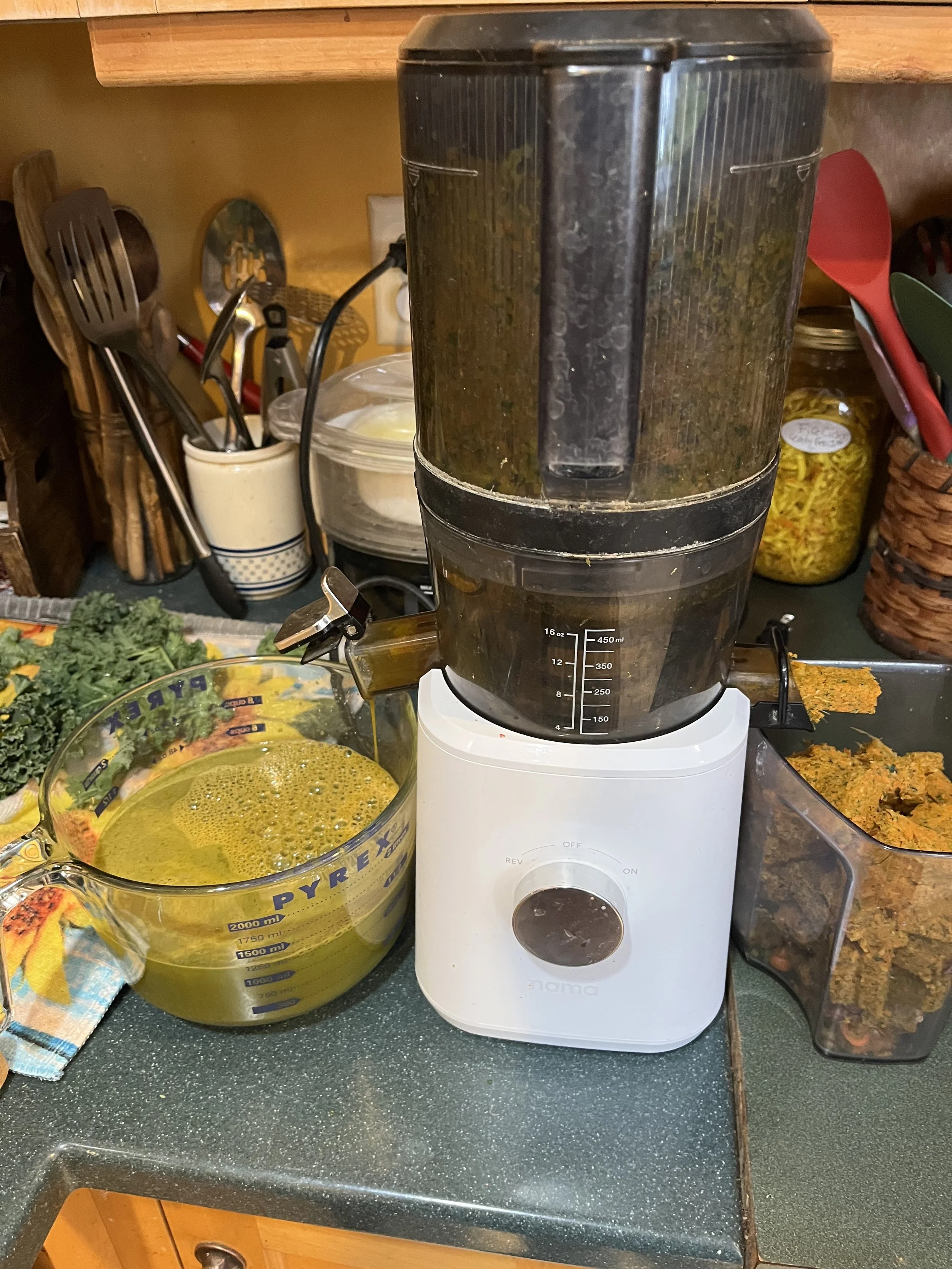
Juicing is the process of seperating the fiber from the liquid that veggies and fruit are made of. So, basically, you buy a juicer, buy a bunch of veggies, wash them, chop them up, and put them in your juicer. The juicer then tears, chews, and grinds your veggies up. This is when the fiber gets seperated from the liquid. Your juicer will have two spouts. One spout extrudes the dry pulp (the fiber) and the other spout is where the extracted juice comes out of. More about different types of juicers later.
Why juice?
Juice gets the nutrients straight into you without your body having to digest any roughage (fiber). Juicing is also an excellent way to consume the nutrients of a wide variety of vegetables. Since there is no fiber for your body to break down and digest, you immediatelt absorb all the nutrients. Don’t get me wrong. We absolutely need fiber. Most people don’t get enough of it. Being whole food plant-based, I get plenty of fiber and protein from the wide variety of raw vegetables I eat.
One of the reasons I enjoy juicing is that I have Fibromyalgia. One of the problems with having fibromyalgia is that my digestion is pretty sluggish. I have been constipated my whole life (if you suffer from constipation you absolutely need to read my journal entry on fermentation! At 51, I have finally found a routine that has helped! Read about it here). Fibromyalgia also makes it difficult for me to absorb nutrients. I typically have to take liquid vitamins or medicine in order to feel the effects of it. Enter juicing! I started juicing about 20 years ago and have tried about 4 or 5 different juicers along the way (more about that later). I juice all sorts of veggies with just a tiny bit of green apple in it so I am getting quite a strong dose of pure nutrients! This has become my daily multi-vitamin.
What’s the difference between juicing and making smoothies?
Juicing: if you put a whole carrot into a juicer you get the liquid nutrients from it. The liquid is extracted from the fiber, seperating the two. Your body instantly absorbs the nutrients.
Smoothies: if you put a whole carrot in a blender, you get the fiber and the liquid.
Both are amazing. I love a good smoothie! (Check out my strawberry beet smoothie below!) Both have different purposes though. WIth juicing, my digestion doesn’t really do much. I absorb the nutrients immediately. This is beneficial if I want to get a straight shot of pure goodness. The other benefit is that even though we all need fiber, and I eat tons of veggies, sometimes it’s hard to eat as many as you need. This is where both juicing and making smoothies is great. I can consume a whole lot more veggies in liquid form. My salads are huge but it takes almost an hour for me to eat them! (I’m working on chewing my food better! That takes a long time!). Juicing and smoothies allows me to get a much larger volume of veggies in my body a lot faster.
Side note: both juice and smoothies have calories. The more fruit you add the more calories you are consuming. Just in case you are counting calories, it might be helpful to look up an app that calculates juice calories. This website is one that I have used to help build recipes and figure out the calorie count for: Juice Recipe Builder. It’s pretty good and it’s free!
What should I juice?
Easy. Vegetables! In the plant-based world there are as many people who poo-poo juicing as there are those that make it part of their daily routine. Why would any not be for it, you may be asking. I have heard a couple different reasons but the main one is the simole fact that you are removing the fiber (an essential part of our diet) when you should be consuming the whole entire carrot with the fiber. I get this and agreee to a point. We absolutely need fiber, as I said before, but I know my body. I know how I feel after I juice. I know what I need. I also know that I am juicing 95% vegetables.
I do agree with the idea that you should not juice too many fruits. While the sugar in the fruit is very different from the processed sugar, it’s still not a great idea to put too much fruit in your juicer. Your body needs the nutrients from the veggies more thatn it needs the sugar from the fruit. Veggies are the way to go. Less sugar, more nutrients.
When you first start juicing, you may be adding a whole apple, a whole pear, ect. I always suggest to people new to juicing that they start like that (one whole apple and lots of veggies) but slowly reduce the amount of fruit they put in as they become accustomed to the taste of juiced veggies. Think 50-50 for a few weeks then 60-40, then 75-25…you get the idea.
Here’s the base for most of my juices:
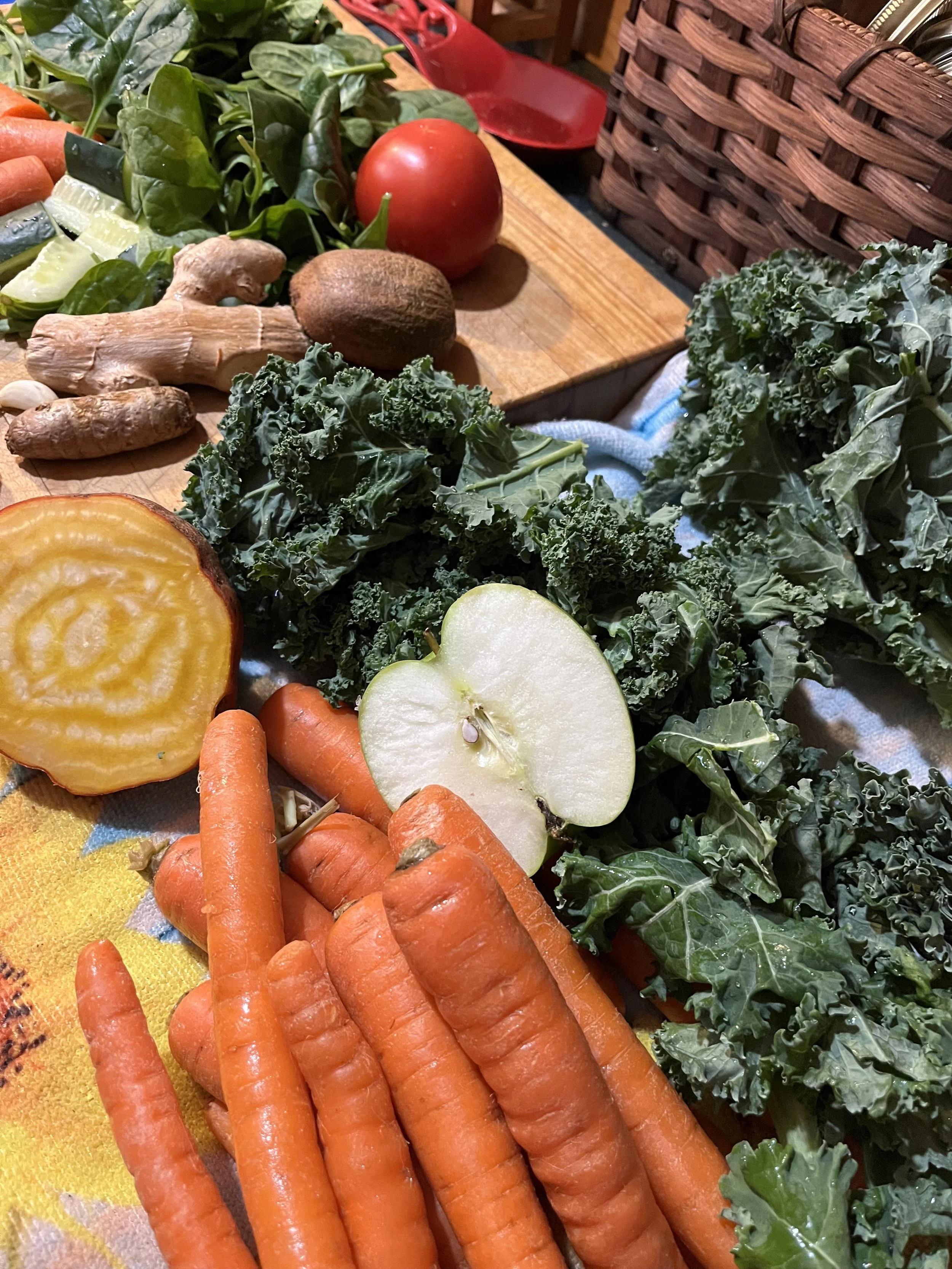
carrot, leafy green (usually kale or spinach), beet, ginger, turmeric, garlic, green apple like granny smith (1/4 of the apple. Green is not as sweet as red)
I like to switch up what I add to this base: cucumber, arugula, cilantro, parsley, pear, grapes, jalepeno, broccoli stem…the list is endless and so much fun to explore!
SIde note: I feel the best time for me to juice is in the morning. It is the first thing with calories that I put in my body. I exercise on an empty stomach and then juice and drink it right away. This works for me but honestly, I think the best time to juice is when it works for you and your schedule. I would highly suggest drinking your juice when your stomach is empty, though.
The Dirty Dozen and the Clean Fifteen
High Priority Organic Produce (The Dirty Dozen) Try to buy these organic:
Strawberries and blueberries: Thin, delicate skins absorb sprays easily.
Spinach, kale, collard, and mustard greens: Large leafy surfaces hold onto residue.
Grapes, peaches, nectarines, and cherries: Soft stone fruits and thin-skinned clusters test high for multiple chemicals.
Apples and pears: Eaten with the skin on, retaining post-harvest treatments.
Potatoes: Root vegetables that grow directly in treated soil.
Bell and hot peppers: Thin outer walls and high spray volumes.
Lower Priority Conventional Produce (The Clean Fifteen) These are typically considered okay to eat even if they are not organic:
Avocados, pineapples, and papayas: Thick outer peels act as a natural shield.
Sweet corn, onions, and sweet peas: Protected husks or pods reduce chemical contact.
Cabbage, cauliflower, and asparagus: Tough outer layers or minimal pest vulnerability.
Watermelon, mangoes, kiwi, and bananas: Protective rinds or peels that are always removed
What kind of juicer should I invest in?
Easy: Masticating or cold press. There are several different types but masticating is best. This seperates the fiber from the juice in a way that produces the least heat, and heat kills enzymes. Heat is the enemy of juice.
This is the slow masticating juicer I currently have: Nama J2 Cold Press. By far the best, and also most expensive juicer I have ever owned. I started with a Champion juicer about 26 years ago. That was an expensive one as well but my mom and I split the cost so it wasn’t too bad. This one runs around $600. One year I got a good tax return and spent the money on that!
If your not ready to make that kind of investment, I totally get it. Here’s some decent cheaper ones to check out on Amazon. Not an exhaustive list but it will get you started, Do your research, check out all the ones within your price range and just make the best decision you can. Stick with Masticating, slow juicer, or cold press type.
Ultimately, the best juicer for you is the one that you will use. All juicers are a pain to clean so don’t let that turn you off from one you can afford and like the design of.
Tips for juicing
As you add veggies to your juicer make sure to alternate leafy greens with harder root veggies. Leafy greens such as kale, arugala, chard and spinach have wonderful nutrients and helath benefits but can be difficult for your juicer to process. Make sure to alternate softer leafy greens (and fruit for that matter) with harder veggies. This should help push the softer stuff through the juicer.
If you are juicing turmeric root, add ground black pepper to your juice for an extra boost of curcumin!
Wash all your veggies and fruit that you are going to juice for the next few days.
Prep bags of veggies to be juiced. For example: after washing all my veg, I let them dry then organize each days juicing inot a green bag. (if you don’t know about green bags, I’m about to change your life, lol: check them out here)
Drink your juice right away. The longer it sits, the more enzymes you lose. Once in a while I do a bulk juicing day where I juice for several days in advance. I portion the juice out into canning jars that have tight fitting lids and store them in the fridge. This is not my favorite thing to do because I always obsess over the lost nutrients. But this may work better for you! If all you can manage time-wise is one day of food prep and want to include your weeks worth of juice, go for it! My current schedule allows me 30 mins in the morning to juice so that’s what I do.
Clean your juicer right after you drink your juice! In a bout of laziness, I have left my juicer sitting all day after I juice and man, is it stinky. All that pulp sits and starts to decompose, and then dries onto the surface of the juicer. Do yourself a favor and clean it right after you juice.
A couple recipes to get you started:
Green Sunshine (beginner)
A great introductory juice with hearty greens and fruit. Wash and chop all veggies. Alternate the hard veggies with the leafy greens and soft fruit. Stir and drink immediately after juicing.
1 leaf of kale (stem and leaf)
1 handful of spinach
½ an orange
½ cup grapes
small nub of ginger (about half the length of your thumb or less)
3 carrots
Strawberry Beet Refresher (beginner)
An earthy yet sweet juice. Wash and chop all veggies. Alternate the hard veggies with the leafy greens and soft fruit. Stir and drink immediately after juicing.
5-6 strawberries (keep the greens on but wash really well before juicing)
½ a small beet
2 leaves of kale (stem and leaf)
2 carrots
Turmeric Power
This juice is packed full of cancer-fighting goodness! Turmeric contains curcumin, which has strong cancer-fighting properties. And add black pepper to the drink to boost that power! Learn more about turmeric here
This juice is not as sweet, so if you are newer to juicing, feel free to add more apple, a handful of grapes, or any other fruit you like.
Wash and chop all veggies. Alternate the hard veggies with the leafy greens and soft fruit. Stir and drink immediately after juicing.
2 leaves of kale (stem and leaf)
½ a green apple (not peeled)
1 thumb of fresh turmeric root
½ a cucumber (not peeled)
3 carrots (not peeled)
After juicing, grind black pepper into the juice (maybe an 1/8th of a tsp.) Stir and drink!
Final thoughts:
I hope you are inspired to expand your health journey! Including juicing into your health routine may be the right thing for you, or it may not be! Everybody’s body is different. My suggestion is to experiment and listen to your body. I am working on adding recipes to my website and plan on having a juicing and smoothie section, so check back later and see what I’ve added!
